For millennia, horses have captivated humans with their beauty, strength and majesty. From Türkiye to Japan, civilizations have elaborately costumed these prized animals. A magnificent selection of saddle covers, horse blankets and other equestrian textiles from the past 1,300 years communicates the significance and status of horses and their riders.
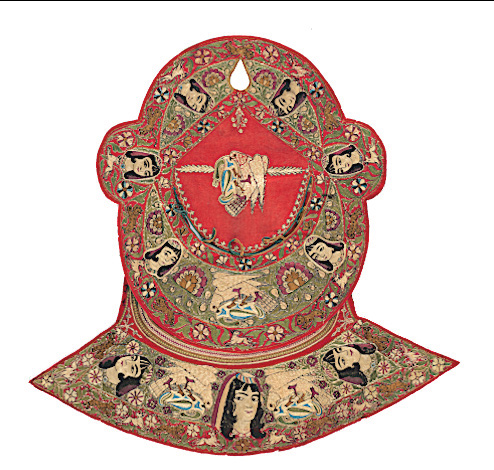
Adorning the Horse: Equestrian Textiles for Power and Prestige — an exhibition of 60 sumptuous equestrian textiles — chronicles over a thousand years of global history through the lens of equine culture. An enchanting 19th-century saddle cover from Iran, crafted with luxurious materials, features figural designs that are deeply intwined with Iran’s cultural heritage. With eight shiny brass bells and a border that was originally bright red, a “shiri gake” (rump cover) from Japan would have enhanced the sights and sounds of a festival, wedding celebration or shrine visit.

The geographic breadth and technical diversity in the show highlights the historical significance of horses in human society, as well as the lifestyles, artistic and cultural traditions, and beliefs of the people who dressed their horses with these exquisitely crafted textiles.
Adorning the Horse is accompanied by a gallery guide. Published on the occasion of the exhibition by Hali Publications, Adorning the Horse, Equestrian Textiles for Power and Prestige, 6th-20th Centuries features highlights from The Textile Museum Collection, and primarily its Brick Freedman Collection.
The limited-edition book features dazzling photography, an introduction by collector and donor Judy Brick Freedman, and new essays by curators Sumru Belger Krody and Lee Talbot, as well as leading historians of equestrian textiles David W. Anthony, Dorcas R. Brown, Thomas Cole, Mariachiara Gasparini and Linda Komaroff. The book is available for purchase in hardback ($55) from the museum’s Artisan’s Gallery and online through Hali Publications.
Support for this exhibition and its accompanying publication is provided by Allen R. and Judy Brick Freedman and the Brick Freedman Endowment for Equestrian Textiles. The exhibition celebrates their 2021 donation to the museum of 100 equestrian textiles and an endowment that provides ongoing support for equestrian textiles as a unique area of study.
EDITOR’S NOTE: The George Washington University Museum and The Textile Museum is located on GW’s Foggy Bottom campus at 701 21st St. NW, in Washington, D.C., just blocks from the Smithsonian Renwick Gallery, White House, Lisner Auditorium and the National Mall. Galleries are open to the public Tuesday through Saturday, 10 a.m. to 5 p.m., closed on university holidays. Admission to the museum is free. For information on the museum’s visiting hours, exhibitions and educational programs, please check the museum website at museum.gwu.edu.