That was the grim message from former Wall Street Journal deputy publisher Dick Tofel to the local news investors who bought and rebuilt The Fauquier Times … and he warned that it’s not if, but when.
“We haven’t had a regular recession in this country in almost 20 years,” Tofel said. “When we have the recession, whenever that’s going to be, you’re going to see an enormous dying of newspapers. It’s going to look like when the comet hit the dinosaurs.”
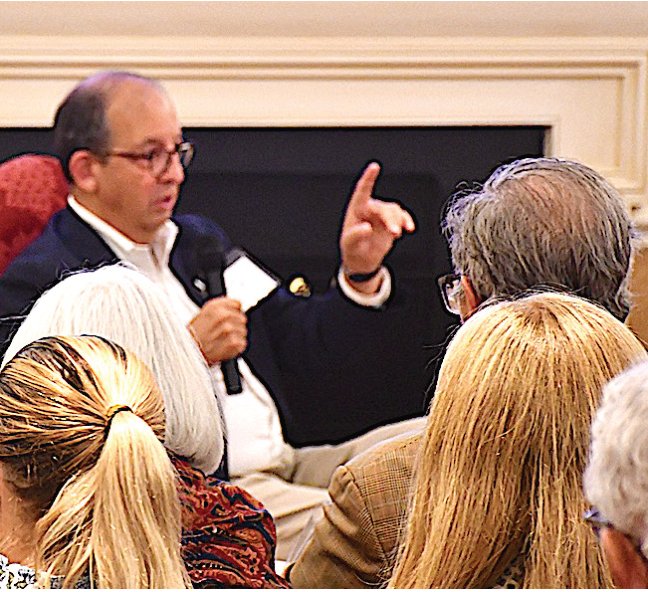
Tofel, who also founded and built the investigative news service ProPublica, spoke at the 10th anniversary celebration of the Piedmont Journalism Foundation, which converted the Fauquier Times and the Prince William Times to nonprofits after the roughly 40 investors got together to buy the paper in 2016.
Interviewed by Foundation Chair Jessica Mathews before a standing-room-only audience at the National Sporting Library and Museum in Middleburg last Thursday evening, Tofel also told the newspaper’s backers that, unlike industry lore, these business problems have not been going on forever.
“The year 2000 was actually the best in the history of the American newspaper industry,” he said.
Then, Tofel explained, in about 2005, with the introduction of consumer broadband, the industry went into a straight downhill slide.
“If you look at the bigger newspaper companies, they have basically been in literally quarter-by-quarter decline, every quarter, now for more than 20 years,” he said.
The reason, Tofel said, is that advertising was the heart of the business and now two-thirds or three-fourths of “all the advertising in this country” goes to Google, Amazon, Meta and a handful of other Silicon Valley companies. Also devastating to the newspapers is how so much activity has moved from print to online, where Tofel said prices have collapsed.
“So the consequence of all this for local journalism has been very terrible,” he said, comparing the loss of local reporters all over the country to what it would be like if all the state troopers disappeared and no one was on the highways to deter speeding. “People would, almost all of them, drive a little faster. Some of them would drive a lot faster. Some would drive unsafely and the number of accidents and injuries would escalate, probably by quite a lot.”
When local journalists disappear, Tofel said, “that is essentially what happens. And there are literally political science studies that show that when local reporters disappear, corruption increases, bond ratings decline, taxes go up, and so you have these really important grassroots consequences.”
Trevor Potter, who lives in Marshall and is the president of Washington’s Campaign Legal Center and was central in the papers’ acquisition, told the group that “just acknowledging the fact that a 10-year anniversary for this project is truly extraordinary,” given all the headwinds that ranged from COVID to discovering “that there was a significant difference between the amount of advertising we understood the paper had, and the advertising it actually turned out to have.”
Potter said the group “significantly lowered costs” to put the papers into financial balance, and at the same time, “we realized that there was the possibility of developing a charitable foundation that could assist the paper and cover some of the costs by hiring good journalists who would produce articles the paper could run.”
It was Jacqueline Mars, he said, who was not only one of the original investors but “encouraged us,” along with Dick Tofel, to explore this path, which back then was “ahead of the curve.”
Indeed, the Piedmont Journalism Foundation was behind the award-winning series written by PJF reporters Chris Stern and Peter Cary that the paper has been running on the impact of data centers.
Tofel, who sat on the jury for The Goldsmith Awards Program administered by the Shorenstein Center on Media, Politics and Public Policy at Harvard, said the series was among the finalists from all over the country that included reporting by The New York Times.
It is this kind of work and effort that raises the question of how much the quality and the journalism matter for the future of local papers, Tofel said. “I think it is everything.”
The papers’ new publisher, Kelly Tremane, who came from the Gannett papers in Ohio, said that despite all of the cutbacks that had to again be made this year, it was critical that full-time reporters continue to make up more than half of the full-time staff members.
He pointed out that when he used to work for the Hartford Courant, one of the oldest newspapers in the country, its circulation was 300,000. Today, he said, not only does the paper operate without a physical building, its circulation has plummeted to 19,000.
Mathews, who was the president of the Carnegie Endowment for International Peace, a former member of the National Security Council in the White House, and a member of the editorial board of the Washington Post, said they plan to continue the success of the in-depth approach of the data center series by looking at other subjects. “We’re debating now which would be the best,” she said. “I don’t think there’s anything as big as the data centers, but there are some huge issues out there that would benefit from an in-depth look. We’ve been through an awful lot and we are now finally in a reasonably stable place where we can focus on developing an aggressive business strategy to grow and to achieve financial sustainability.”
“We do believe that if local journalism can succeed anywhere, it can succeed here,” she said.